
Waste Exemption Changes 2027–2028: Is Your Business Ready?
By David Alcock, Senior Environmental Consultant, AC Environmental
If your business operates under a waste exemption in England, there are some important changes coming from January 2027.
The new rules are expected to come into force on 6 January 2027, subject to parliamentary approval.
T8, T9 and U16 are being withdrawn, and the Environment Agency’s current guidance gives affected operators until 6 April 2027 to apply for an appropriate environmental permit if they want to continue those activities.
The Environment Agency is also introducing new conditions for several other waste exemptions, with further deadlines in July 2027 and January 2028. Depending on the activities carried out at your site, you may need to change how you store, treat or manage waste to remain compliant.
Last reviewed: 13 November 2026
How could this affect your business?
For example, if you recover scrap metal under T9, mechanically treat waste tyres under T8, or remove parts from depolluted end-of-life vehicles under U16, you’ll need to review your operations before applying for an environmental permit.
It’s not just a case of replacing your exemption with a permit. You’ll need to consider the waste you handle, how it’s stored and treated, and whether your site meets the requirements of the permit you need.
My advice is to check these things early. Identifying any issues now could help avoid delays as the 6 April 2027 deadline approaches.
Not sure whether these changes affect your site?
If you operate under one or more waste exemptions and aren’t sure what the new rules mean for your business, give us a call. At AC Environmental, we can review your existing exemptions and help you understand whether you need to make changes or apply for an environmental permit.
Call 01782 308 444 to discuss your site.
Don’t wait until March to check whether you need a new environmental permit.
Permit applications take time to prepare, and not every site will qualify for a standard rules permit. If you need a bespoke permit, additional assessments and supporting information may be required.
The sooner you establish what’s needed, the more time you’ll have to prepare your application before the 6 April 2027 deadline.
What is changing with waste exemptions?
The Environment Agency is withdrawing certain waste exemptions and tightening the conditions of others from January 2027. Businesses affected by the changes may need an environmental permit or adjustments to their existing operations to remain compliant.
Waste exemptions allow businesses to carry out certain waste activities without an environmental permit, provided they stay within the conditions of their registered exemptions.
The changes are intended to reduce environmental risks associated with poorly managed waste sites and help tackle waste crime. They affect businesses across several sectors, including waste recycling, treatment, storage, construction and agriculture.
Not every business will need an environmental permit. However, if your site relies on one or more exemptions, I’d recommend checking whether your activities will still meet the revised conditions.
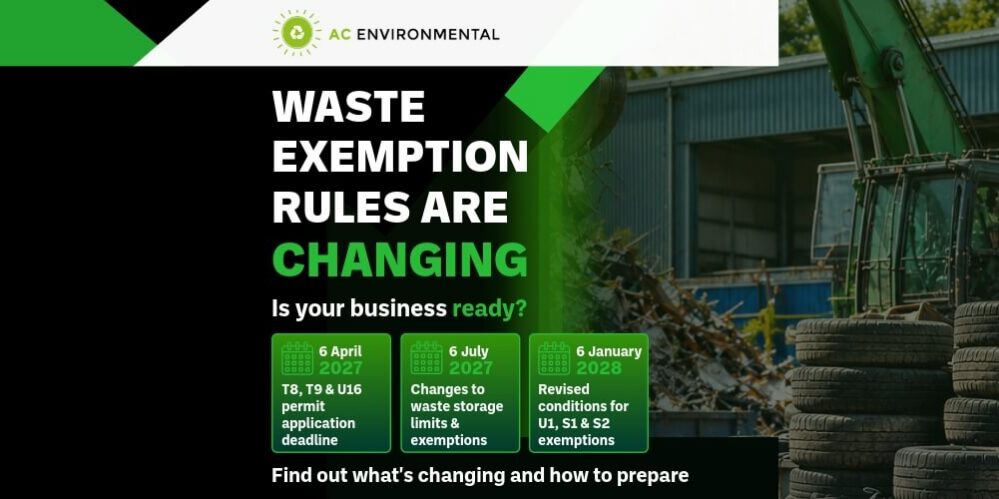
The new rules are expected to take effect on 6 January 2027, subject to parliamentary approval. The changes are expected to apply from that date, with transition periods of different lengths, as shown below. The full transitional arrangements have not yet been published, so the deadlines below reflect the Environment Agency’s current guidance and remain subject to the final legislation.
Waste exemption changes: key deadlines
| Deadline | Exemptions affected | What operators need to know |
|---|---|---|
| 6 April 2027 | T8, T9 and U16 | End of the three-month transition period. Operators wishing to continue the affected activities should apply for an appropriate environmental permit before this date, unless they already have the necessary authorisation. |
| 6 July 2027 | T4, T6, T12 and D7 | Revised exemption conditions apply, alongside changes affecting multiple exemptions and technically connected activities. |
| 6 January 2028 | U1, S1 and S2 | Revised conditions may affect the waste types, quantities and storage or use arrangements permitted under these exemptions. |
Before looking at the deadlines in more detail, there are a few questions I’d recommend asking about your site:
- Do you know which waste exemptions are currently registered at your site?
- Are you operating within the waste types, quantities and conditions allowed by those exemptions?
- Do you carry out any exempt activities alongside activities covered by an environmental permit?
- Will your current activities still meet the revised exemption conditions?
If you’re unsure about any of these, it’s worth reviewing your arrangements before the new rules come into force.
T8, T9 and U16 – What happens before 6 April 2027?
Three waste exemptions are scheduled to be withdrawn altogether:
- T8 – Mechanically treating end-of-life tyres
- T9 – Recovering scrap metal
- U16 – Using depolluted end-of-life vehicles for parts
If your business relies on one of these exemptions and wants to continue the affected activities, you’ll need to apply for a suitable standard rules or bespoke environmental permit before the transition period ends on 6 April 2027.
Can you continue operating while your permit application is being determined?
The Environment Agency’s current guidance indicates that operators who apply for an appropriate environmental permit before 6 April 2027 can continue working under their existing exemption while their application is being determined.
However, the full transitional arrangements have not yet been confirmed, so it’s important to check the requirements once they’re published. Operators should also allow enough time to prepare an application with the necessary supporting information and correct fee before the relevant deadline.
That’s why I’d recommend starting the process now. Preparing a permit application can take time, particularly if your site requires a bespoke permit or additional supporting assessments.
At AC Environmental, we can review your activities, establish which permit you need and help you prepare your application in good time.
Call 01782 308 444 to discuss your site and what you’ll need before 6 April 2027.
6 July 2027 – Changes to waste treatment and storage rules
The second major deadline affects several exemptions that will remain available but have revised conditions:
- T4 – Preparatory treatment of waste
- T6 – Treating waste wood and plant matter
- T12 – Manually treating waste
- D7 – Burning plant and untreated wood waste where it is produced
If your site uses any of these exemptions, you’ll need to check whether the revised rules change the types or quantities of waste you can handle, or how you carry out your activities.
There are also two important changes affecting businesses that operate under multiple exemptions or hold an environmental permit alongside their exemptions.
What happens if you operate under multiple waste exemptions?
Where several exemptions cover the same type of waste at one site, the lowest applicable storage limit will apply to the combined quantity stored.
This means you may no longer be able to rely on the separate storage allowances of different exemptions to increase the total amount of the same waste stored at your site.
If the new combined storage limit is lower than the quantity of waste you currently hold, you’ll need to review your storage arrangements. This may mean reducing the amount of waste stored, applying for an appropriate environmental permit or stopping the affected activity.
If you can’t stay within the lowest storage limit, the Environment Agency’s current guidance says you’ll need to apply for an environmental permit or stop the affected activity. Operators who apply before 6 July 2027 are expected to be able to continue working while their application is processed, subject to the applicable transitional requirements.
Exempt activities alongside environmental permits
If you operate waste exemptions alongside an environmental permit, you’ll need to check whether those activities are technically connected.
This depends on the activities carried out and whether they could increase the environmental risks associated with your permitted operations.
Where there is a technical connection, you’ll need to apply to bring the exempt activities into your environmental permit by 6 July 2027 or stop carrying them out under the exemption after that date.
Simply holding an exemption and an environmental permit at the same site does not automatically mean the activities are technically connected.
If you operate under several exemptions or already hold an environmental permit, I’d recommend reviewing how your activities fit together.
You may find that some activities need adding to your existing permit or that a separate permit application is required.
6 January 2028 – New conditions for U1, S1 and S2 exemptions
The final major transition deadline affects three commonly used exemptions:
- U1 – Using waste in construction
- S1 – Storing waste in secure containers
- S2 – Storing waste at a secure site
All three exemptions will remain available, but their conditions are changing.
Depending on the exemption, the revised requirements may affect which waste types can be used or stored, the quantities permitted and the conditions that operators must meet.
If your business operates under S2, I’d pay particular attention to the new storage limits. Depending on the waste you handle, these could affect how much you’re allowed to keep at your site.
If your current activities fall outside the revised conditions, you may need to reduce the quantities you handle, change your operations or apply for an environmental permit.
January 2028 might seem a long way off, but I’d encourage you to check the revised conditions sooner rather than later.
If your business relies on S1 or S2 to store waste, for example, you’ll want to know well in advance whether your current storage arrangements will still comply.
Frequently asked questions
When do the new waste exemption rules come into force?
The new rules are expected to come into force on 6 January 2027, subject to parliamentary approval. Some changes then have transition periods, with deadlines in April 2027, July 2027 and January 2028. The changes apply in England.
Which waste exemptions are being withdrawn?
T8 (mechanically treating end-of-life tyres), T9 (recovering scrap metal) and U16 (using depolluted end-of-life vehicles for parts) are being withdrawn. The Environment Agency’s current guidance gives operators until 6 April 2027 to apply for an environmental permit if they want to continue those activities.
Can I keep operating under T8, T9 or U16 while my permit application is processed?
The Environment Agency’s current guidance says that operators who apply for an appropriate environmental permit before 6 April 2027 can continue working under their existing exemption while the application is processed. The full transitional arrangements have not yet been published, so it’s worth preparing your application early.
What changes on 6 July 2027?
Revised conditions are expected to apply to T4, T6, T12 and D7. From the same date, if you have more than one exemption registered at a site, the amount of each waste type you can store will be limited to the lowest limit among those exemptions.
What if I can’t stay within the new storage limit for multiple exemptions?
You’ll need to apply for an environmental permit or stop the affected activity. The Environment Agency’s current guidance says that once you’ve applied, you can continue the work while your application is processed.
I hold an environmental permit and waste exemptions at the same site. What do I need to do?
You’ll need to decide whether your exemptions are technically connected to your permitted activity, meaning they could increase the site’s overall environmental risk. If they are, you’ll need to apply to bring them into your permit by 6 July 2027 or stop those activities under the exemption.
What changes for U1, S1 and S2?
All three exemptions remain available, but their conditions change at the end of a 12-month transition period on 6 January 2028. The changes may affect which waste types you can use or store, and in what quantities.
Do the changes apply in Wales?
No. This guidance covers England. The Welsh Government is making its own changes to waste exemptions, and Natural Resources Wales has said it will write to exemption holders once the date is confirmed.
How can AC Environmental help?
If you’re unsure whether these changes affect your business, the best starting point is to review the exemptions you currently operate under and check them against the new requirements.
We can do that with you.
At AC Environmental, we’ll review the activities carried out at your site, identify which changes apply and explain whether you need to adjust your operations, apply for a new environmental permit or vary an existing one.
If a permit is required, we can help prepare and submit the application, whether that’s for a standard rules or bespoke environmental permit.
We can also provide Certificate of Technical Competence (COTC) cover where required.
We offer fixed-fee planning and permitting services, so you’ll know our agreed fees before work begins.
Our aim is to make the process as straightforward as possible, giving you clear advice on what’s required and enough time to prepare.
Not sure where your site stands?
Whether you operate under T8, T9, U16 or another waste exemption, we’re happy to discuss your site and help you understand what needs to happen next.
Call AC Environmental on 01782 308 444
Website: www.ac-environmental.co.uk
This article is based on the Environment Agency’s guidance updated on 21 October 2026. The proposed changes apply to England and remain subject to parliamentary approval. Full details of the transitional arrangements have not yet been published, so this article reflects what is currently expected. We’ll update it once they are confirmed. Every waste site is different, so if you’re unsure how the changes affect your business, please get in touch.
Official guidance: Waste exemptions: new rules from January 2027